New paper: Self-Defeating Privacy: Privacy Coins as a Blockchain Liability
|
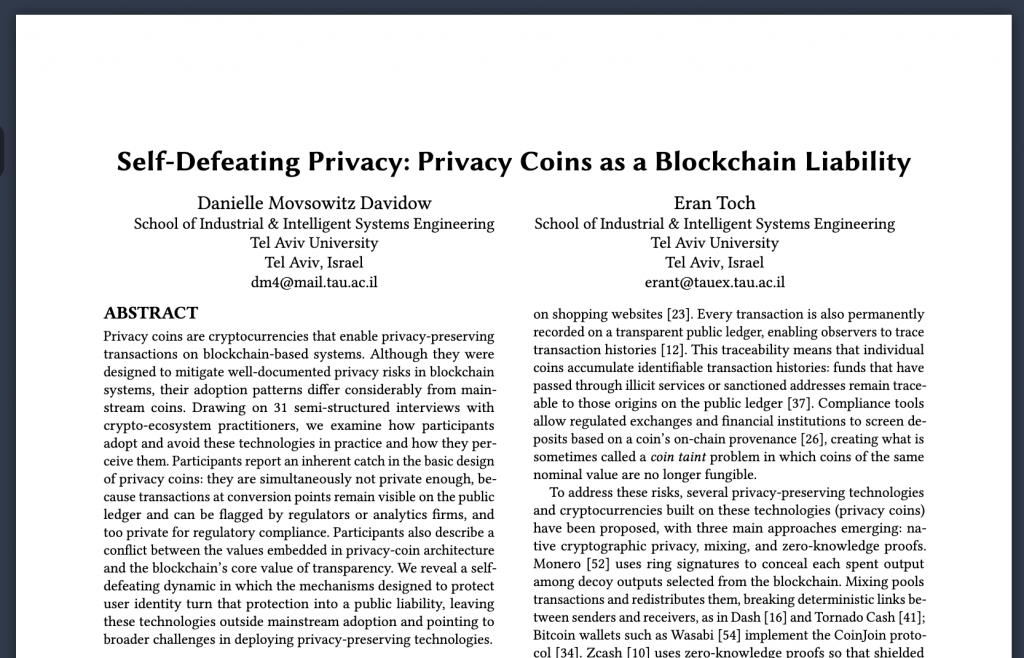
We are happy to share that our paper, “Self-Defeating Privacy: Privacy Coins as a Blockchain Liability,” by Danielle Movsowitz Davidow and Eran Toch, has been accepted as a short paper to the 25th Workshop on Privacy in the Electronic Society (WPES 2026). Privacy coins such as Monero and Zcash are designed to address a fundamental problem with blockchain: transactions recorded on a public ledger can often be traced back to real-world identities. But our study shows a paradox: using a technology designed to protect your privacy can itself become a privacy liability. Drawing on 31 interviews with cryptocurrency practitioners, we identify a process of flagging. Because interactions with privacy technologies can remain visible at entry and exit points, using a privacy coin can itself become a signal—potentially suggesting to exchanges, regulators, or others that the user has “something to hide.” We show how this extends previous research on the flagging effects of privacy-enhancing technologies. On blockchain, flagging is particularly consequential: the trace can be permanent, and stigma can attach not only to users but to the money itself, creating “tainted” coins that institutions may treat with suspicion. This creates a self-defeating dynamic: privacy coins can be simultaneously not private enough and too private—not private enough to prevent users and funds from being flagged, yet too private to meet regulatory demands for transparency. More broadly, the study shows why privacy cannot be understood through technical guarantees alone: we also need to consider what concealing information reveals. The paper will be presented at WPES 2026 in The Hague in November.
|