Author Archives: erant
Congratulations to Frank!
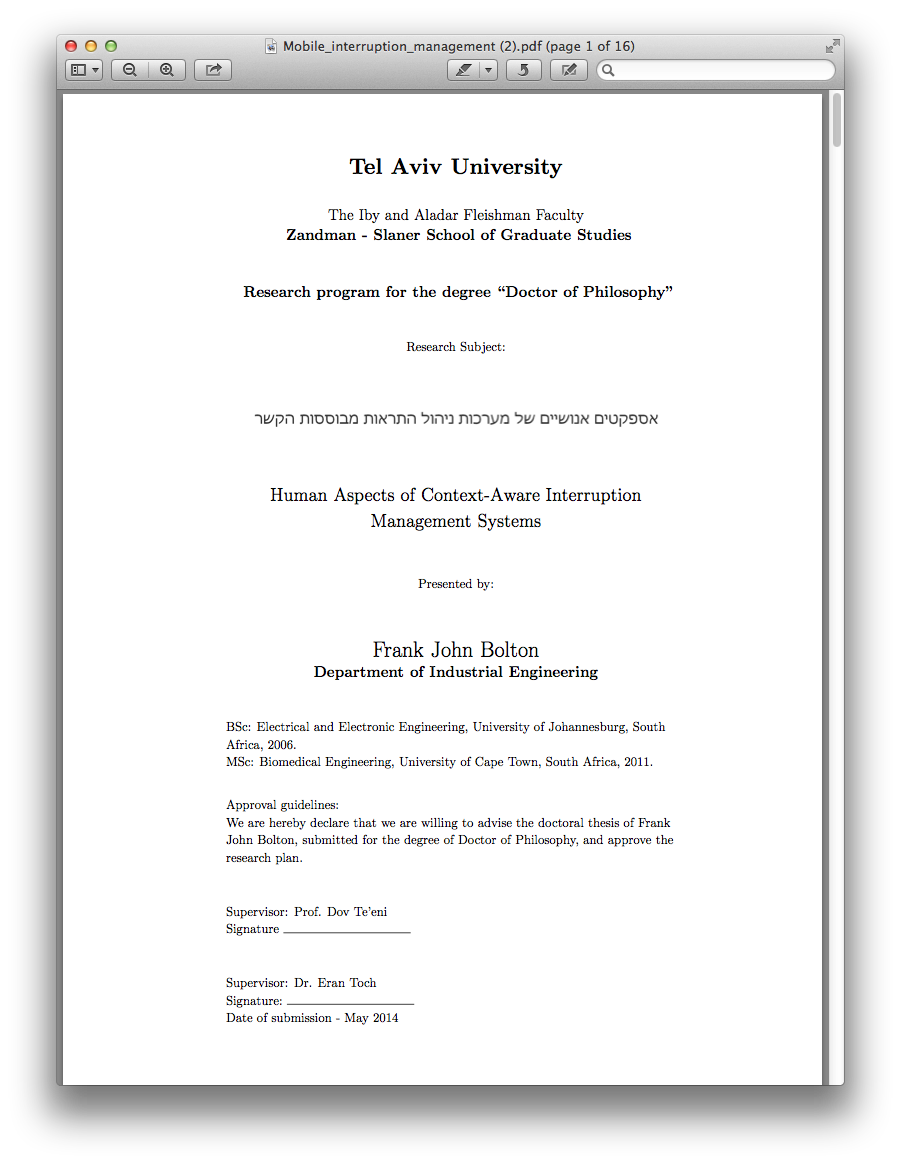
Congratulations to Frank Bolton, who just passed his Ph.D. thesis proposal defence! The exam went smoothly, even without any Iron Dome sirens 🙂 Frank’s thesis is about “Human Aspects of Context-Aware Interruption Management Systems”, with the objective of making interruption
Congratulations to Frank!
Congratulations to Frank Bolton, who just passed his Ph.D. thesis proposal defence! The exam went smoothly, even without any Iron Dome sirens 🙂 Frank’s thesis is about “Human Aspects of Context-Aware Interruption Management Systems”, with the objective of making interruption
Video: personal privacy
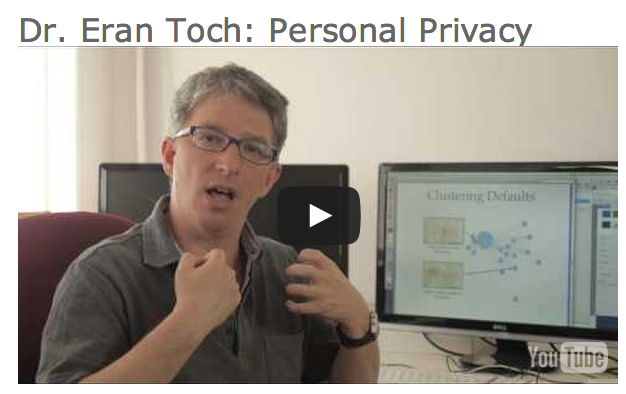
The American Friends of Tel Aviv University were kind enough to film me speaking about research challenges in personal privacy.
Video: personal privacy
The American Friends of Tel Aviv University were kind enough to film me speaking about research challenges in personal privacy.
New Video Lecture: Privacy in the World of Engineers
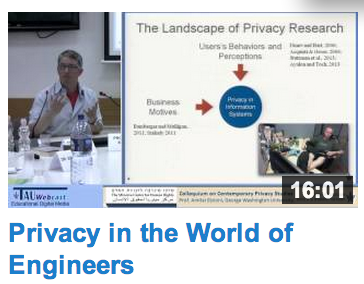
A video of Eran’s lecture on “Privacy in the World of Engineers”, is now live, thanks to Michael Birnhack. The lecture was given in a Colloquium on Contemporary Privacy Studies, hosting Professor Amitai Etzioni from George Washington University. The lecture presents the current results from the
New Video Lecture: Privacy in the World of Engineers
A video of Eran’s lecture on “Privacy in the World of Engineers”, is now live, thanks to Michael Birnhack. The lecture was given in a Colloquium on Contemporary Privacy Studies, hosting Professor Amitai Etzioni from George Washington University. The lecture presents the current results from the
Our department’s new promotion video
Our department of Industrial Engineering has a nifty new promotional video (in Hebrew). In the video, they interview a student, a lecturer (Prof. Irad Ben Gal, our collaborator), and a (proud) graduate of our department, giving a complete view on
Our department’s new promotion video
Our department of Industrial Engineering has a nifty new promotional video (in Hebrew). In the video, they interview a student, a lecturer (Prof. Irad Ben Gal, our collaborator), and a (proud) graduate of our department, giving a complete view on
Our work is presented at the 2014 Privacy Law Scholars Conference (PLSC)
Michael Birnhack has presented a paper draft by Birnhack, Eran Toch, and Irit Hadar work, “Privacy Mindset, Engineering Mindset”, at the Seventh Annual Privacy Law Scholars Conference (PLSC), hosted by The George Washington School of Law.
Our work is presented at the 2014 Privacy Law Scholars Conference (PLSC)
Michael Birnhack has presented a paper draft by Birnhack, Eran Toch, and Irit Hadar work, “Privacy Mindset, Engineering Mindset”, at the Seventh Annual Privacy Law Scholars Conference (PLSC), hosted by The George Washington School of Law.
I am a senior lecturer now. Yay!
I was promoted to senior lecturer! Yay! Its just another step in a long academic ladder, but its sweet anyway 🙂 I owe it mainly to my students, who’s creativity and hard work are the reason for this news. Events
I am a senior lecturer now. Yay!
I was promoted to senior lecturer! Yay! Its just another step in a long academic ladder, but its sweet anyway 🙂 I owe it mainly to my students, who’s creativity and hard work are the reason for this news. Events
Two papers accepted to the Telecommunications Policy Research Conference (TPRC)
Two papers were accepted to TPRC, the 42nd Research Conference on Communication, Information and Internet Policy! The conference itself will be held at September 12-14, 2014, at George Mason University School of Law, Arlington, VA, USA. The conference is a meeting point
Two papers accepted to the Telecommunications Policy Research Conference (TPRC)
Two papers were accepted to TPRC, the 42nd Research Conference on Communication, Information and Internet Policy! The conference itself will be held at September 12-14, 2014, at George Mason University School of Law, Arlington, VA, USA. The conference is a meeting point